Everything You've Been Told About What Moves Markets Is Wrong
Over three decades involved in currency markets. 9,587 scored forecasts. One conclusion became unavoidable: the conventional wisdom that drives most market decisions is fundamentally flawed – and nobody in the financial industry has any incentive to tell you why.
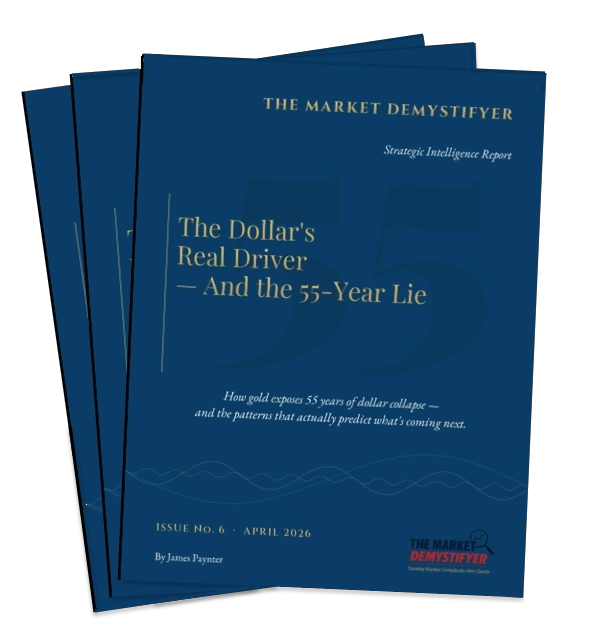
Market Demystifyer is a monthly research publication that makes complex economic and financial concepts clear in plain business language. Each issue challenges accepted market norms, tests conventional theories against decades of real data – and then provides you with an outlook based on what actually drives the markets, not on what the economists and market pundits are telling you.
Backed by 20+ years of market research and published forecast analysis – scored against real market outcomes.
60-day money-back guarantee. Cancel anytime.
The Market Experts Keep Getting It Wrong – and Nobody Asks Why
How many times have market “gurus” told you the Fed controls rates – only to watch rates do the exact opposite of what the Fed would like?
How often have you heard that raising interest rates strengthens a currency – yet seen the exact opposite happen?
How many “surprise” market crashes have caught you off guard – when they could have been anticipated with the right framework?
The fact is, conventional economic analysis is fundamentally flawed for one simple reason – it ignores what actually drives the market: mass human psychology.
The Fed controls interest rates – tested against 25 years of data, the correlation is 41%. A coin flip.
Higher rates strengthen the dollar – again, the data says otherwise. Every accepted norm, once tested, falls apart.
Non-Farm Payrolls move the market – statistically insignificant beyond 4 hours. The “king of announcements” is a court jester for predicting direction.
Makes sense in theory, right? But what is the reality? Every issue of Market Demystifyer puts these accepted norms to the test – and the results will change how you think about markets.
Markets Are Driven by Mass Human Emotion – Not Economic Theories
Markets are driven by persons taking action based on how they are feeling – not by events or news. Understanding this changed everything.
Meese and Rogoff demonstrated in 1983 that fundamental economic models cannot outperform a random walk at forecasting exchange rates. The research has been replicated dozens of times since. The models your bank uses to generate their outlook are the same ones that have failed this test for over forty years.
Yet the entire financial industry – the banks, the economists, the media – continues to rely on these models. Because they have no incentive to tell you they don't work. Their job is to sound authoritative, not to be right.
Conventional Analysis
Bank research, Bloomberg, CNBC, economic forecasts. Tells you what happened and speculates about why. Built on models that have failed the same test for 40+ years.
Market Demystifyer
Tests every accepted norm against real data. Shows you what actually drives markets. Gives you an outlook based on evidence, not consensus.
A Publication That Shows You How Markets Actually Work
Market Demystifyer is built by James Paynter – over three decades in currency markets, 20+ years of published forecasts, every one scored against real market outcomes. No retroactive editing. No selective reporting.
Each issue takes the accepted wisdom – the things the economists, the banks, and the financial media tell you are true – and tests them against decades of actual data. When the data disagrees with the theory, we show you why, and what the evidence says you should be watching instead.
The result is not just analysis. It is an education in how markets actually work – one that unlearns the assumptions the industry has taught you, and replaces them with what the data has consistently shown over 20+ years.
The track record behind this publication is public, falsifiable, and continuously updated.
What Makes This Different from Everything Else You Read
The analysts, banks, economists and media you already follow aren't missing information – but they're inside (and reacting to) the crowd they're supposed to be reading. Each Intelligence Report shows you the same markets – from outside the crowd.
Unlike economists, whose theoretical models have failed to outperform a random walk at forecasting for over 40 years, we examine the same economic subjects through angles you won’t find in conventional analysis.
Each issue takes one major economic or financial topic and looks at it from a perspective that conventional economics misses entirely. The US economy read as a P&L. The Fed balance sheet analyzed like a corporate report. 39 years of tariff history traced from a newspaper ad to Liberation Day. Not simplified versions of complex subjects – different ways of looking at the same facts that reveal what the economists’ models don’t.
Unlike the banks, who explain what happened after the fact, we publish specific cycle targets and timing windows – and score every call against outcomes.
Issue #1 (October 2025) called Bitcoin’s correction from the $126,272 high – Bitcoin was at $80,000 by December. The same issue flagged Gold’s pullback at $4,000 and set the next leg target above $4,750; Gold is $5,195 today. Both published before the move, not after.
Unlike mainstream media, who regurgitate the same narratives with no accountability for the outcomes, we challenge orthodox theory with data – 915 global forecasts scored against actual outcomes since 2019.
Each issue debunks a widely held market belief using historical data anyone can verify. The same methodology behind 8,672 scored Rand forecasts is applied to DXY, EUR/USD, Gold, and Bitcoin. Not ‘our method has an edge’ – here are the forecasts, here are the outcomes, you can verify it.
And what all four have in common is that they’re inside the crowd, reacting to the same sentiment they’re supposed to be analysing. Once you see that pattern, you start reading every one of their signals in a different light.
The fear embedded in a ‘cautious’ bank forecast. The consensus running through a media narrative. The momentum-chasing in a signals alert. The model that can’t account for what the model can’t see. TMD doesn’t just add a view to your stack – it changes the frame you bring to every view you encounter.
Everything in this section was published before the outcome. That's the difference between Reuters, CNN, Fox Business, Fin24, CNBC – and analysis you can actually act on.
What You Receive Each Month
The Deep Dive Analysis
The centrepiece of every issue. One major economic or financial topic reframed in business language – the US economy as a P&L, the federal balance sheet as a corporate report, 39 years of tariff history traced from a newspaper ad to Liberation Day. Complex subjects made clear through a lens that makes sense to a business owner.
Myth-Busting
Every issue takes widely accepted financial “truths” and tests them against 25+ years of actual data. Higher rates strengthen the dollar? 41% correlation – a coin flip. NFP drives currency moves? Statistically insignificant beyond 4 hours.
“Makes sense in theory. But what is the reality?”
Market Snapshot
Specific price targets across stocks, currencies, crypto, precious metals, and commodities – directional, chart-backed, cycle-positioned. Issue #1 called Bitcoin's correction from $126,272 and set Gold's next-leg target above $4,750, both before the moves happened. This is not market commentary – it's a before-the-fact record you can check.
The Framework
The thread connecting every issue: markets move on mass human psychology, not economic fundamentals. Each issue reinforces this through the data, building a framework for reading market cycles rather than reacting to news. Over time, you don't just receive analysis – you understand the approach well enough to think in cycles yourself.

James Paynter
Over three decades in currency markets. 20+ years of published, scored forecasts. Every issue written personally – not by a team, not by AI, not by a junior analyst.
How One Issue Changed a Consensus Position
A recent issue examined why inflation does not weaken currencies the way textbooks claim. The standard model says inflation erodes purchasing power, which weakens the currency. Logical. Clean. And demonstrably wrong at every critical juncture since 2020.
The issue traced the actual mechanism: inflation triggers rate hikes, rate hikes attract capital flows, capital flows strengthen the currency. The weakness comes later – and only under specific conditions that the standard model doesn’t distinguish from the initial phase.
Readers who understood this sequence in 2021 were positioned for dollar strength while the consensus was calling for inflation-driven weakness.
This is the pattern in every issue: one myth dismantled, the real mechanism explained, and the cycle position that tells you what it means for your decisions right now.
The Consensus Gets It Wrong at Exactly the Moments That Matter
In September 2022, Bank of America's Global Fund Manager Survey– covering roughly $1.1 trillion in assets – found that 64% of fund managers named “long US dollar” the most crowded trade in markets.Four consecutive months at the top of the list. The “dollar wrecking ball” narrative was on every Bloomberg panel and bank research desk. The dollar was unstoppable.
The dollar peaked that exact month.Over the following 18 months, it fell 15%. In every prior instance over 20 years where the BofA “most crowded trade” reading exceeded 60%, it has preceded a reversal. Every single time. But at the moment of maximum consensus conviction, there was no model and no analyst warning you the top was in.
This is not an isolated failure. Reuters polled 40+ economists before the 2024 US election – the consensus was positioned for dollar weakness. The dollar surged instead.
The pattern is structural, not accidental. Consensus forecasts are built from the same models, fed by the same data, produced by analysts who read each other's work. At inflection points – exactly when you most need to be right – the consensus converges on the same wrong answer.
Market Demystifyer exists because of this pattern.Every issue examines where the consensus diverges from cycle structure – and what that divergence historically means for your timing decisions. Not speculation. Evidence, traced across 20+ years of documented outcomes.
Two investors, same starting capital, different frameworks.
Investor A: The Informed Guesser
Reads everything. Follows Bloomberg, CNBC, three bank research desks, two newsletters.
Makes decisions when conviction is highest – which is when consensus is strongest – which is when the cycle is about to turn.
Over 10 years: occasional wins, systematic losses at inflection points. Net result: underperformance against a simple passive benchmark.
Investor B: The Cycle Timing Strategist
Reads one source. Understands where they are in the cycle. Acts when the framework says act, waits when it says wait.
Ignores consensus at extremes – which is uncomfortable – but the 20+ year track record shows this discomfort is precisely where the edge lives.
Over 10 years: consistent, documented, repeatable timing edge. Not because they are smarter. Because the framework removes consensus at the worst moments.
Warren Buffett built his fortune on a single principle: be fearful when others are greedy, and greedy when others are fearful. That principle is impossible to execute on gut feel alone. It requires a framework that tells you where the crowd is – and where the cycle is. That is what Market Demystifyer provides every month.
The question is not whether $29 or $49 per month is worth it. The question is whether you want to be Investor A or Investor B over the next 3 months, 12 months, 5 years.
James Paynter
Founder, Dynamic Outcomes
On most platforms, you are a subscriber number. Your questions go to a support queue. Your concerns get a templated response. You never interact with the person whose name is on the research.
Market Demystifyer is different. I write every issue and I score every forecast, and every one of those scores sits in the public archive under my name.
20+ Years of Published, Scored, Falsifiable Forecasts
The claims above would be meaningless without a public track record. Here is what exists, and how you can verify it yourself.
Every forecast is published before the fact. Every outcome is scored and recorded. The same methodology behind 20+ years of scored Rand forecasting is what drives the global market analysis in each issue.
This is not a claim of perfection. Transparency about what we get wrong is part of the credibility of what we get right.
Market Demystifyer Serves Three Types of Reader
What unites all three: you have tried the information approach. And the timing problem persists.
Serious Investors
Managing meaningful capital who have grown distrustful of consensus analysis. You want independent, evidence-based analysis from someone with no incentive to move you into a trade.
Business Owners & CFOs
Importers, exporters, treasury managers – who know that a 5% swing on their exposure can be the difference between a profitable quarter and a disaster. You need timing intelligence, not more economic commentary.
Corporate Treasury
Managing structured hedging programmes who need analysis they can document, audit, and defend to a board. Cycle-based timing provides the systematic, evidence-backed framework that market feel never can.
Choose the tier that matches how you use the analysis.
Base
For investors and executives who want the monthly deep dive and market outlook.
- Monthly Strategic Intelligence Report – one market belief tested against the historical record
- Myth-busting analysis with verifiable historical data
- Where the US Dollar Index, EUR/USD, Gold and Bitcoin stand
- Every issue published from the date you subscribe onward
- Bonus reports at sign-up and periodically
Pro
For readers who use the analysis operationally – market decisions, hedge programmes, or advising clients.
- Everything in Market Demystifyer
- Fortnightly forecasts: US Dollar Index, EUR/USD, Gold, Bitcoin
- Live signal charts
- Price and forecast alerts you set (email + SMS)
Both tiers deliver every issue published from the date you subscribe. Issues published before that are a separate one-time purchase. All prices in USD. No lock-in contracts.
The Cost of This vs. the Cost of Not Having It
Bloomberg Terminal
$2,000+
per month
Bank FX Advisory
Free*
*you pay via the spread
Market Demystifyer
$29–$49
per month
If one decision per year is informed by cycle timing instead of consensus – one hedge timed better, one entry level chosen by cycle position rather than news – the return on a $348 or $588 annual subscription cost is measured in multiples, not percentages.
No lock-in, no commitment, no penalties – cancel anytime.
Every paid tier carries a 60-day money-back guarantee. Cancel anytime, on any tier. No contract, no exit fee, and no automated annual renewal trap.
If the analysis does not deliver more useful market intelligence than your current sources, ask for your money back inside 60 days and you have lost nothing.
The publication either proves its value in the first issue or it does not. We are comfortable with that standard because the content has been proving it consistently across 20+ years of published research.
Stop Accepting What the Market Tells You. Start Understanding What Drives It.
You can continue relying on the same conventional analysis that has failed the same tests for over forty years – the bank reports, the economist forecasts, the media narratives that sound authoritative but consistently get it wrong at the moments that matter.
Or you can subscribe to a publication that challenges every accepted norm, tests every theory against real data, and shows you what actually drives the markets – backed by over three decades of experience and 20+ years of published, scored forecasts.
Market Demystifyer is a research publication. It is not financial advice. Past forecast performance does not guarantee future results. All forecasts are probabilistic – some of them are wrong. You should consult a qualified financial advisor before making investment or hedging decisions. Track record numbers reflect scored forecasts as of April 2026 and are independently verifiable at forexforecasts.co.za.